
Fast Partners
In 2026 and beyond, the sophisticated reach of a networked organization is not enough. It's no longer about the reach of the skills network, but also the speed with which they operate.

“If you are the fastest person in the room, you are in the wrong room.” - Futurist Jim Carroll
Futurist Jim Carroll is writing his end-of-2025 / introduction-to-2026 series, 26 Principles for 2026. You can follow along at 2026.jimcarroll.com. He welcomes your comments.
The 1987 editorial “Tomorrow’s Company Won’t Have Walls“ stands as one of the most accurate corporate prophecies of the modern era.
And it had a profound impact on my life.
It’s probably fair to say that if I hadn’t read it, I wouldn’t have stepped out on my own to start my own company, chase my own career, do my own thing, and become a global freelancer, a nomadic worker, a lone wolf, long before the trend became real and the idea fashionable. Like I’ve said - I haven’t had a job for 35 years, and I work really hard to not have to get a job!
It’s worth reading, because it predicted with precision the modern organization of today.
“Tomorrow’s Company Won’t Have Walls”, New York Times, October 1987
The hub of the network organization will be small, centralized, and local. At the same time, it will be connected to an extended network that is big, decentralized, and global. People from the network and from outside the company will join the group at the hub for periods of time and then leave it.
But the network organization will also present its own set of paradoxes. For instance, how will these new organizations be able to manage the often conflicting interests of the centralized hub and the decentralized network? And how can a system that is both centralized and decentralized be unified and coordinated, and quick to respond to changes in the marketplace?
For the global organization of the future, the ability to acquire new products, services, technologies, and capital will not be the problem. The marketplace is crowded with each of these as never before.
But for exactly this reason, the challenge for each company will be to nurture its own unique culture and develop the quality of its human resources. That is because competitive advantage will rest increasingly in the way each network organization gathers and assesses information, makes its decisions, and then carries out those decisions.
The 21st century will be full of organizational surprises. The challenge of arranging cooperative efforts between companies to achieve strategic gains is beginning to emerge. Changes in the marketplace have given companies from around the world the opportunity to develop these new linkages. Advances in telecommunications technology also enable companies to bring people together for a competitive advantage. The time has now come to form new global collections of companies, and to fully utilize human relationships.
Think about where we are now: many organizations don’t define themselves by the depth of their staff - they do so by the reach of their skills network.
But in 2026 and beyond, the sophisticated reach of a networked organization is not enough.
It’s no longer about the reach of your skills network, but also the speed with which they operate.
If they aren’t as fast as you, it will slow you down even further, stunt your progress, and ruin your ability to align with exponential trends.
Here’s your chalkboard summary!
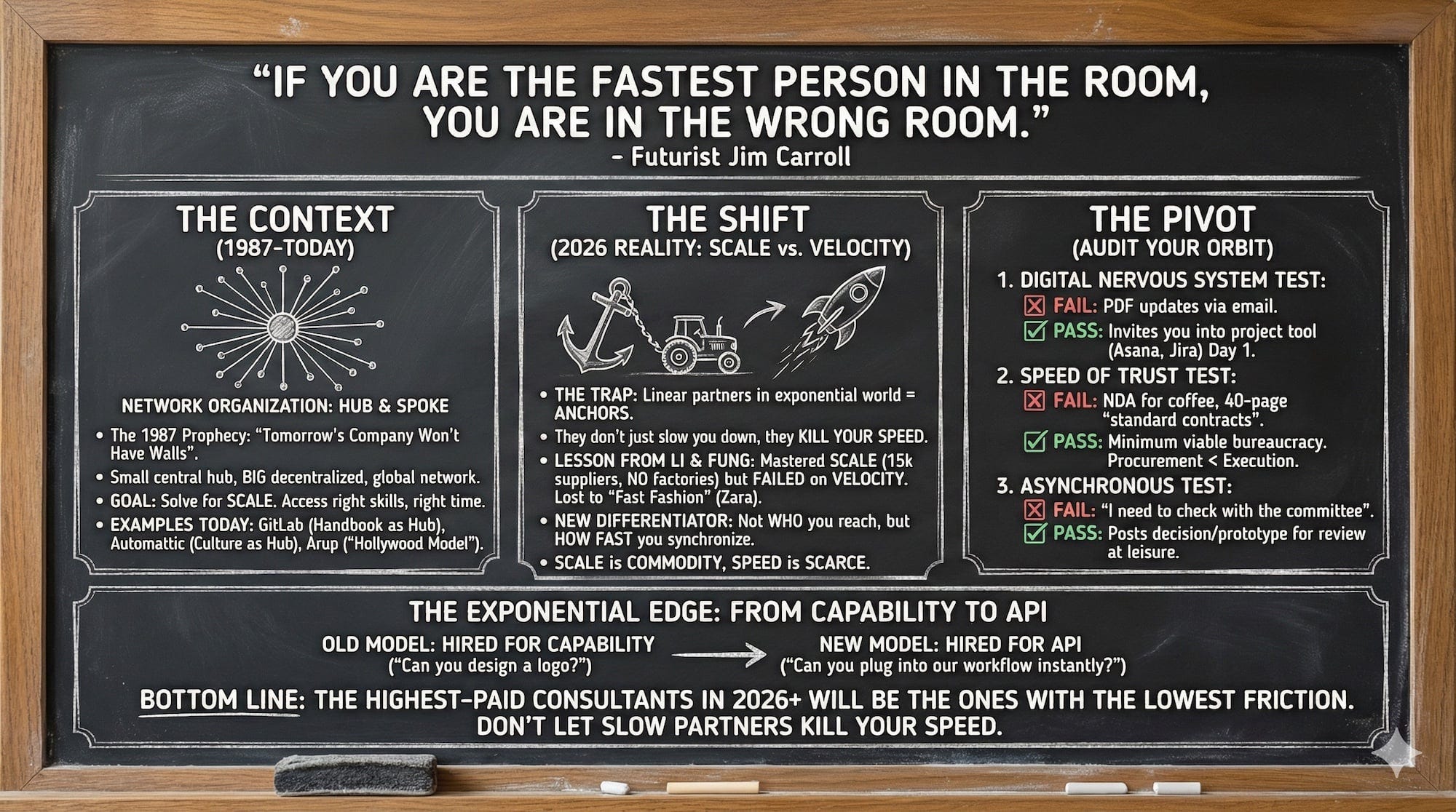
That’s why, in 2026 and beyond, you have to stop letting slow partners kill your speed.
The Issue of Network Velocity
We are on Day 20. We have built your internal engine: You have the Unapologetic Uniqueness (Day 17), an Antifragile Mindset (Day 18), and Optionality Architecture (Day 19).
Do those things, and you are getting ready for our exponential world.
But as they say, “but wait, there’s more!” Now, we must look outside.
You can have a Ferrari engine (your mindset), but if you are driving in a convoy of tractors (your partners), you are going to move at the speed of a tractor!
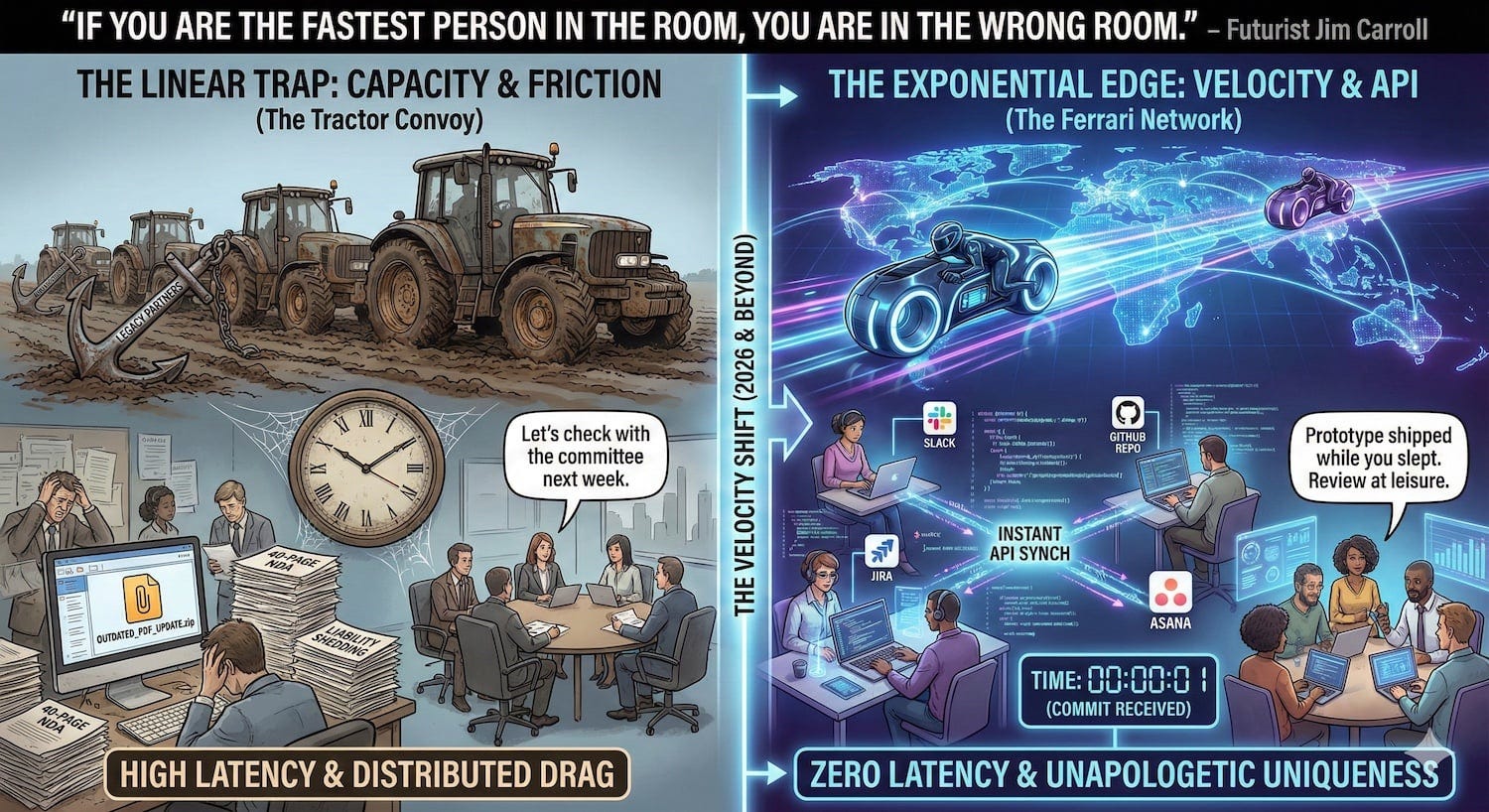
And here’s the thing about what this means to the networked organization, and perhaps your role in it as a freelancer: in a linear world, we picked partners based on stability, history, and comfort. We stuck with the vendor we’d used for 20 years because “they know us.”
In an exponential world, loyalty to the past is a guarantee for failure. If your supply chain, your technology vendors, or your peer group are evolving linearly while the market accelerates exponentially, they aren’t just slowing you down.
They are anchors.
This means that another discipline you must master going forward is Network Velocity.
Here’s why.
Keep reading with a 7-day free trial
Subscribe to Jim Carroll's Daily Inspiration to keep reading this post and get 7 days of free access to the full post archives.