
Shift!
Despite all the hype with AI, it's not that specific careers will be dying, but it's certain they will be transforming.

“In a world of constant change, the most valuable degree is the one that teaches you how to keep learning.” - Futurist Jim Carroll
A few weeks ago, I spoke to folks at the Guelph Wellington Men’s Club - a networking community in the new city where i live. The topic? AI. The room? Jam-packed with retirees - judges, lawyers, doctors, executives, tradesmen. Standing room only with a crowd intensely interested in what I had to say.
As is often the case, I get followup email when I strike their interest. Here’s one:
I have several grandchildren who are approaching university age, and I was wondering if you would be able to send me the table that showed the various careers that were going to die and which ones were going to thrive. I have looked up several of these tables on the internet, but they did not prove to be very enlightening--they stated that careers that were going to thrive were obscure blue-collar jobs, not the ones that my grandchildren would be aspiring to.
I told the fellow I’d follow up by writing my answer into a blog post, and so here it is!
The key thing is - despite all the hype with AI, it’s not that specific careers will be dying, but it’s certain they will be transforming.
Can we prepare a table showing which careers will die and which will thrive? Not really.
The hard truth is that the future of work can no longer be summarized in a simple list of “safe” vs. “unsafe” job titles. Instead of a table of dead careers, I encourage students to look at a table of transforming skills.
Stop looking for careers that won’t change—they no longer exist. The future of work isn’t about a simple list of “safe“ jobs, but about the velocity of their transformation. There is absolutely no doubt that professions like medicine, law, and agriculture are being massively transformed and completely redefined by’ the machine.’ Yet, rather than being replaced by AI, they will be changed - and within the profession, there will be dozens, if not hundreds, of new micro-specialities. Just like today - but bigger.
That being said, the next generation must move beyond static job titles and instead master the art of the pivot.
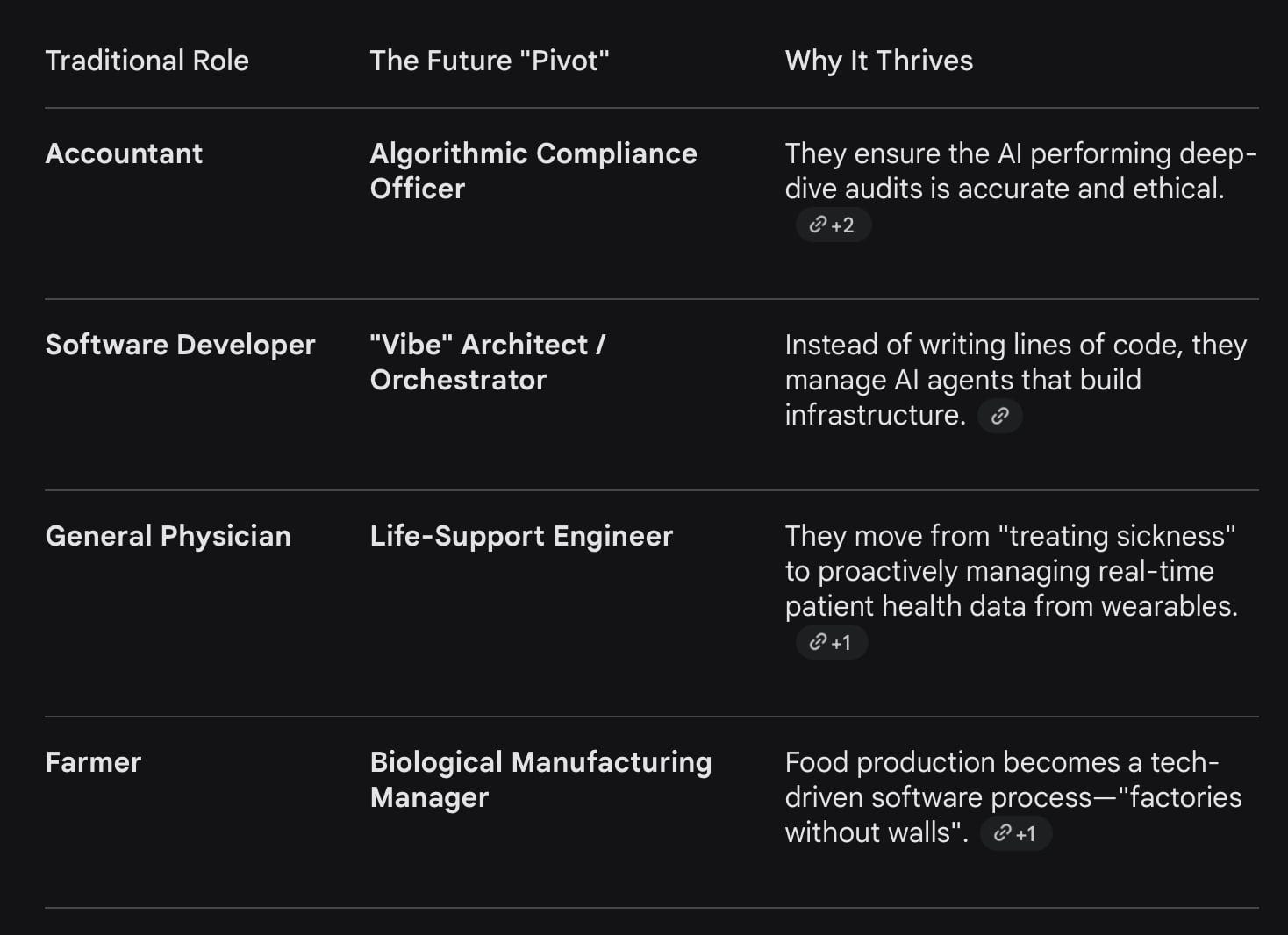
The question then becomes: is a university degree still worthwhile?
Most definitely! In this era of rapid transformation, the question is not whether a degree is worthwhile, but how it is used. It’s foundational knowledge that gets you on a path to tomorrow - a path that will go through tremendous twists and turns.
Traditional paths like finance, law, medicine, agricultural science, and engineering are not “disappearing,” but their fundamental structures are being rewritten. The careers will exist - but will be forever changed. The same type of thinking applies:
Law: The role is shifting toward managing AI-driven case analysis and ethical algorithmic oversight rather than just billable hours.
Finance: Money is becoming an “invisible” part of the economy’s operating system, requiring professionals who understand embedded finance and algorithmic compliance.
Engineering: This field is merging into the use of new tools and technologies, where advanced 3D printing and digital twins transform the entire process.
Agricultural Science: This is becoming managed by data scientists and biological engineers who oversee predictable, tech-driven innovation and management
When I speak to young people today, I give them three pieces of advice that are far more valuable than any job list:
Master “Just-in-Time” Learning: The half-life of a professional skill is now about five years. Success comes from how fast you can learn what you need to know tomorrow, rather than what you know today. Take more courses on learning how to learn, whatever that might be.
Embrace “Algorithmic Partnership“: The competition isn’t “Man vs. Machine“; it’s “You + AI” vs. “You Alone“. Students shouldn’t just “use” AI; they should redesign their personal productivity around it. Make sure to take several computer science courses to understand it all (knowing the knowledge you get here will soon be out of date, but it will give you a firm foundation)
Build “Optionality Architecture”: Know that the five-year career plan is dead. Students should build a portfolio of diverse skills and pivots that allow them to shift as industries blur and disappear. (They already know that, though!)
My advice? Don’t look for a career that won’t change. It doesn’t exist. In a world of synthetic perfection and automated “average,” the market will reward the bold, the human, and the “unapologetically unique”.
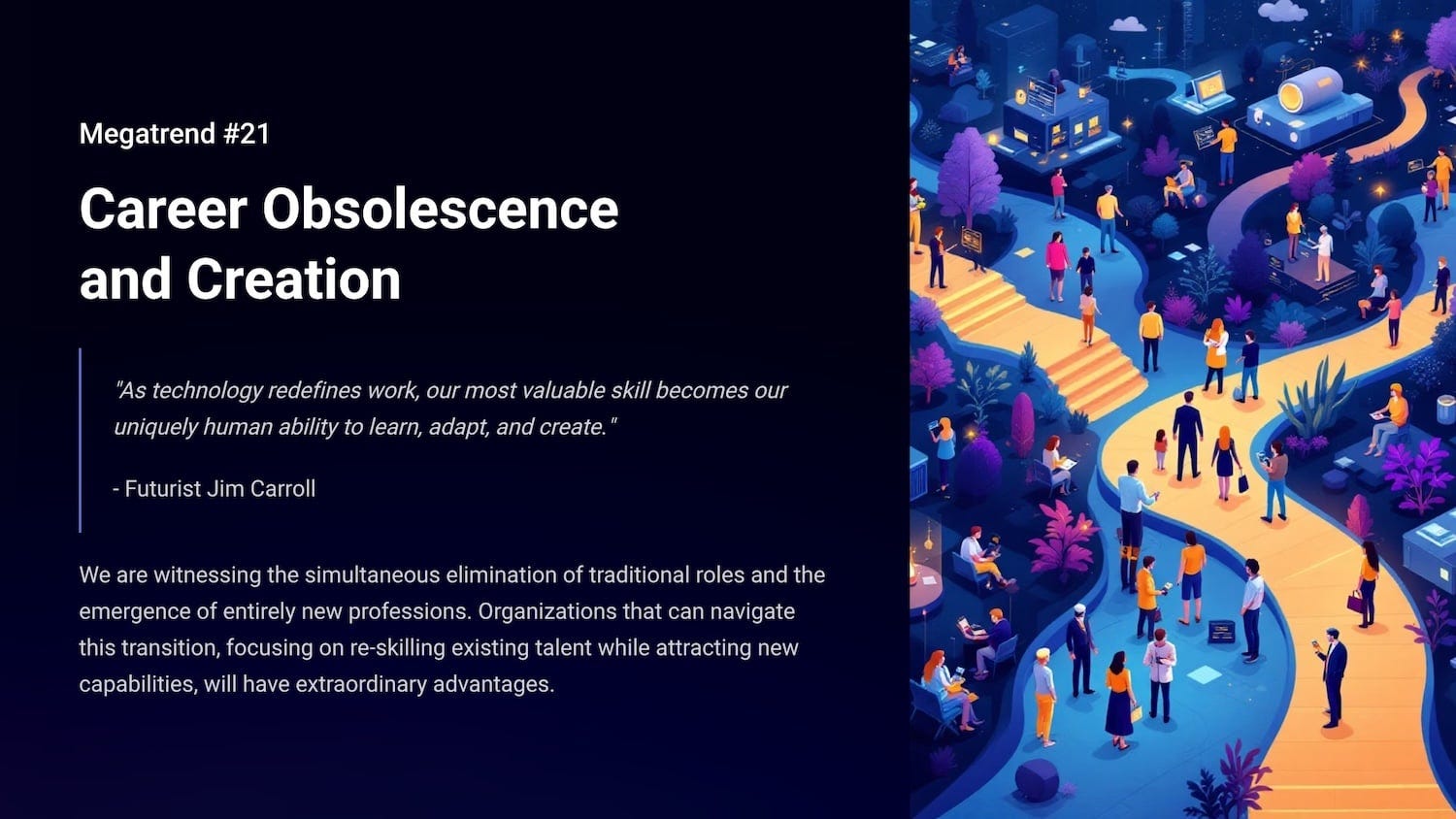
I wrote about all this in my Megatrends series: The Great Rebalancing, noting that “as technology redefines work, our most valuable skill becomes our uniquely human ability to learn, adapt, and create.”
Bottom line? There will still be lawyers and doctors - but they will be very different lawyers and doctors! That being the case, there’s nothing wrong with chasing traditional university-based education. But also know, there’s nothing wrong with being an electrician or plumber - those career paths, too, will be forever changed!
The future belongs to the “fast,” and the fast are those who are already preparing for the next pivot in their chosen profession!
Futurist Jim Carroll believes that the idea of ‘just-in=time knowledge’, a phrase he coined in 1997, is the key to all future career success.